

"God's self-disclosure is that permanent revolution in our religious life by which all religious truths are painfully transformed and all religious behavior transfigured by repentance and new faith." — H. Richard Niebuhr, The Meaning of Revelation
Anyone who learned to drive a car with a manual gearbox carries in their body a small parable of transformation: the teenager who once assumed driving was simply a matter of pointing the car and pressing the pedal, who then stalled in the middle of an intersection to a chorus of horns, who spent months consciously sequencing clutch, gear, mirror, and indicator, and who now, years later, arrives home with no memory of having changed gear at all. Educators have long mapped this pathway as the four stages of competence, a model developed by Noel Burch at Gordon Training International in the 1970s, which traces the learner's passage from unconscious incompetence, through conscious incompetence and conscious competence, into the settled fluency of unconscious competence.
In the years since I wrote Metanoia, I have been struck by how precisely this simple model traces the contours of the Metanoia Journey we describe in that book. Both follow the same U-shaped descent and ascent that we argued lies at the heart of all genuine learning, visible in developmental psychology, in Campbell's monomyth, and supremely in the incarnation, death, and resurrection of Jesus, the Arch Hero of the whole story. Laid over one another, the two maps illuminate each other, and together they give leaders a remarkably clear account of why transformation feels the way it does at each stage, and why so many individuals and organizations abandon the journey at the very point where God is preparing to meet them.
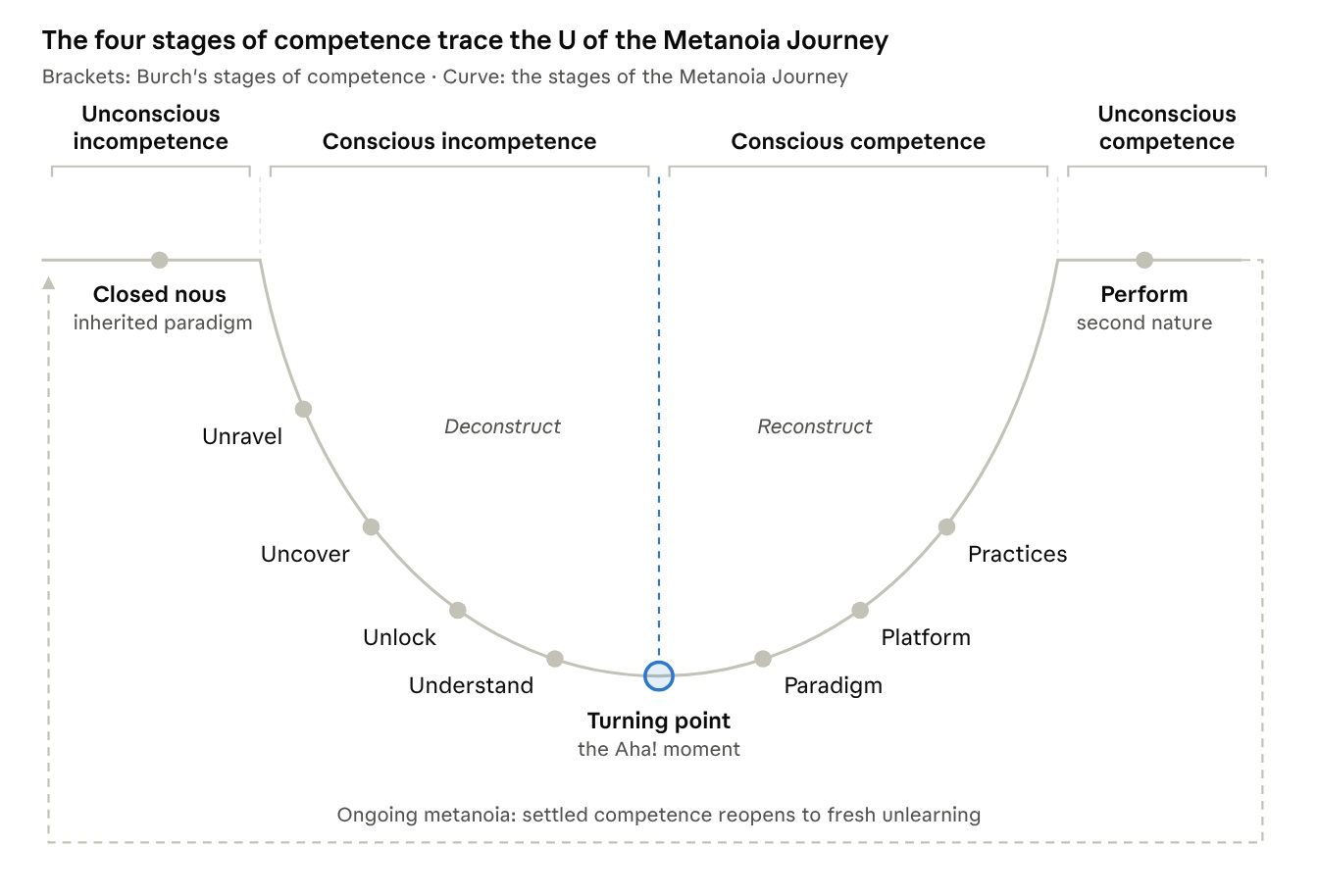
The downcurve of the Metanoia Journey is the season of conscious incompetence, the upcurve is conscious competence, and the turning point at the bottom of the U is the hinge between them, with the loop carrying every settled competence back into fresh metanoia.
Unconscious Incompetence: The Closed Mind
Every metanoic journey begins in a condition its travelers cannot yet see, because the very paradigm that holds them captive is the lens through which they perceive everything else. The New Testament calls this lens the nous (mind and rationale), that complex system of narratives, assumptions, concepts, values, and practices by which a person or a community construes reality, and when the nous is closed, its ideologies and idolatries pass for common sense and its blind spots feel like solid ground. Paul's plea that we be transformed by the renewing of our minds (Rom 12:2) presupposes exactly this state of conformity to an age whose patterns we absorb long before we ever think to question them.
In organizational terms, this is the church or ministry that keeps producing precisely the results its system was designed to produce, sincerely and faithfully, with little awareness that its inherited assumptions about leadership, gathering, and mission are themselves the source of its stuckness. The wicked problem is already present and already shaping outcomes, and the leaders remain largely untroubled by it, because it lies beneath the threshold of their perception. Jesus' sobering words to the Laodiceans, who considered themselves rich and in need of nothing while being poor, blind, and naked (Rev 3:17), describe the spiritual texture of unconscious incompetence with uncomfortable accuracy, and his counsel to buy salve for their eyes is the first summons onto the Metanoia Journey.
Conscious Incompetence: The Downcurve of Deconstruction
The journey proper begins when the anomalies of the prevailing paradigm break through into awareness, usually through a crisis that is felt as a genuine threat, a coming apart at the seams that can no longer be explained away. Here the learner discovers what the competence model calls conscious incompetence, the disorienting and often humiliating knowledge of what we do not know, and here the four stages of the downcurve in the Metanoia Journey chart the terrain with some precision:
Unravel, where the organization becomes aware of paradigmatic issues, identifies systemic dysfunction, and embraces its wicked problem as an adaptive challenge requiring new learning.
Uncover, where leaders sense the whole system with softened eyes, expose its flaws and movement blockers, begin the hard work of unlearning, and lament their unfaithfulness.
Unlock, where the imagination roams across new frontiers, broadly maps their contours, and prayerfully and playfully prefigures possibilities within a culture of experiential learning.
Understand, where the search intensifies for the patterns and meta-ideas around which a reformulated paradigm might cohere.
This is the via negativa, the ancient apophatic way of unknowing that theologians have long recognized as a necessary companion to the way of knowing, and it is the stage at which most leaders lose their nerve. Conscious incompetence carries the felt weight of failure, it exposes our cherished competencies as partial, and it strips away the reassurance of having answers. Those who persevere through it, engaging the crisis with the whole heart of mind, soul, and will, discover that the descent itself is forming in them the openness and humility without which no real spiritual progress is possible.
The Turning Point: Grace at the Bottom of the U
At this point the Metanoia Journey adds something the four-stage model leaves implicit, and it is here that the theological weight of the comparison is felt most keenly. Burch's model describes a progression from conscious incompetence to conscious competence, and the Metanoia Journey locates the hinge of that progression at the bottom of the curve, in the place of nakedness and openness before God, the abyss of the hero's journey, where Israel wandered forty years in the wilderness and where Jesus passed through the darkness of the cross before the dawn of resurrection.
Here insight arrives as something given and received, the Aha! moment experienced with the force of a conversion, in which we come to see something in such a way that it can never be unseen. Every learner who has passed from fumbling to fluency knows the moment when the pieces suddenly click into a coherent whole, and Scripture names the source of that illumination: the God who said, "Let light shine out of darkness," shining in our hearts to give the light of the knowledge of his glory in the face of Christ (2 Cor 4:6). The passage from incompetence to competence, read through Metanoia, turns on an act of God meeting us in the valley, which is why the downcurve is endured in hope, and why metanoia is rightly received as gift long before it is ever exercised as discipline.
Conscious Competence: The Upcurve of Reconstruction
Having received the insight, the learner must now learn deliberately to live it, and this is the long, effortful season the competence model calls conscious competence. The new way is possible now, and it still requires concentration, intention, and practice at every turn, much as the learner driver must think through each gear change. On the upcurve of the Metanoia Journey, this work unfolds across three stages that engage the whole heart of the organization:
Paradigm engages the mind, forming a new mental map, solidifying the meta-ideas, and formulating a DNA that can be fractalized throughout the organization.
Platform engages the soul, setting the culture, nurturing a vibrant spirituality, and building movemental structures designed for scale.
Practices engages the will, developing organizational rhythms that embed the meta-ideas in everyday life, along with the tools and training pathways that allow them to multiply.
This is the long obedience in the same direction that Eugene Peterson commended, the working out of our salvation with fear and trembling (Phil 2:12) in which God is already at work in us to will and to act according to his good purpose. Every new practice feels awkward and costly in this season, and every repetition is quietly laying down the grooves along which the new paradigm will eventually run with ease.
Unconscious Competence: The Rehabituated Life
The final stage of the competence model describes a fluency so complete that the skill has passed into the body and the instincts, and the Perform stage of the Metanoia Journey describes the same reality at the level of a whole organization. Here the meta-ideas have been so thoroughly embedded in culture, structures, and practices that they find expression instinctively in cultural health, in learning and growth, in movement scaling, and in what we called the organizational sweet spot, where the system now produces movemental fruit as naturally as it once produced institutional inertia.
In Metanoia we described the metanoic process as releasing individuals and organizations from cycles of brokenness and rehabituating them to patterns more consistent with Jesus and his cause, and this is precisely what unconscious competence means for the disciple and the church alike. It is the mind of Christ (1 Cor 2:16) becoming second nature, the fruit of the Spirit emerging as the spontaneous overflow of a renewed nous, the life of Jesus reproducing itself through people who increasingly think, feel, and act in his way without having to rehearse each step. Discipleship reaches its intended fullness here, in a people whose very reflexes have been conformed to Christ.
The Spiral of Ongoing Metanoia
The deepest alignment between the two maps appears where the journey seems to end, because unconscious competence, left unattended, quietly becomes the next unconscious incompetence. The paradigm that once liberated us gradually hardens into the very lens we can no longer see, the practices that once expressed living faith settle into the habits of a new orthodoxy, and the organization that broke free of one set of assumptions finds itself, a generation later, captive to another. Every movement in church history that has calcified into an institution testifies to this dynamic, and it is why we insisted in Metanoia that un/learning is a continuous loop of letting go and adapting, a system that must be kept open as long as we follow a living Lord.
Read through the lens of metanoia, the four stages of competence become a spiral of discipleship, each completed cycle opening onto a wider horizon of understanding and a fuller participation in the life of the ever-greater God. Susanne Langer described true learning as a horizon that widens in all directions at once with every upward step, and that image captures the joy at the heart of the whole process: each descent into the valley of unknowing becomes the doorway to a larger vision of Jesus, a more faithful expression of his church, and a deeper share in his mission to the world. Metanoia, as Niebuhr saw, is God's permanent revolution in our religious life, and the four stages give us a practical grammar for taking our part in it, again and again, until we see him face to face.
Key Takeaways
Unconscious incompetence is the closed nous, the condition of every person and organization held captive by an inherited paradigm whose blind spots feel like solid ground.
Conscious incompetence is the downcurve of deconstruction, where Unravel, Uncover, Unlock, and Understand lead us through the painful and necessary way of unknowing.
The turning point is grace, the Aha! moment at the bottom of the U where God meets us in the valley and gives the insight that reorders everything.
Conscious competence is the upcurve of reconstruction, where Paradigm, Platform, and Practices engage the mind, soul, and will in the deliberate work of living the new way.
Unconscious competence is the rehabituated life, the Perform stage in which the mind of Christ becomes second nature for disciples and organizations alike.
The journey is a spiral, because every settled competence must eventually be reopened to fresh metanoia as we follow the ever-greater God into ever-wider horizons.
The Deeper Journey
Defintely take a through read of the book Metanoia. I wished I had learned this earlier in my ministry.
We are about to publish a Metanoia Journey Handbook. Lands the plane in the local arena. Stay tuned
Engage with the AI Lab on this site. Ask it questions regarding metanoia, unlearning, relearning, change processing, etc. I think you will be amazed.