



[A follow-up article to the previous article highlighting the need for systems awareness in church leadership. In this article I explore what is called a Forcefield Analysis, a tool that I have found to be very useful in helping become aware of systemic problems in the organization. Another workshop article will follow]
In social psychology and organizational dynamics, the social theorist Kurt Lewin pioneered a tool called a Force-Field Analysis, establishing that any social system exists in a state of dynamic equilibrium—a tug-of-war between two opposing sets of energies: Driving Forces (Boosters) that push toward change, and Restraining Forces (Blockers) that fight to preserve the status quo.
When church leaders experience frustration because their discipleship initiatives stall, their default reaction is almost always to push harder on the booster side of the equation:
Add more passionate preaching about mission.
Introduce a new bible-study curriculum.
Exhort the congregation to pray more, witness more, and give more.
Launch a new programmatic initiative.
But in the perspective of systems-dynamics, pushing harder on a system that is held in place by powerful balancing loops is an exercise in futility. Peter Senge noted that when you apply brute force to a balancing system without addressing the underlying constraints, the system pushes right back with equal and opposite resistance to maintain its homeostatic equilibrium. Robert Fritz called this dynamic ‘structural conflict’: and it acts like a rubber band anchored to an implicit reality or belief that pulls you right back the harder you stretch toward your vision.
The living-systems premise is straightforward: Living systems are already hardwired for health, growth, and reproduction. In the human body, you do not need to command an embryo to form fingers, lungs, or a heart; the developmental code is already latent within the cell. If a body becomes sick or stunted, the primary task is not to force growth, but to diagnose and remove the toxins and blockages.
Jesus has already placed the genetic code of Apostolic Genius (the six elements of mDNA) within His body, the ecclesia. If we want to release multiplying movements, the primary strategic task is not to manufacture more driving energy, but to systematically locate, dismantle, and remove the structural blockers that cancel out our missional intent.
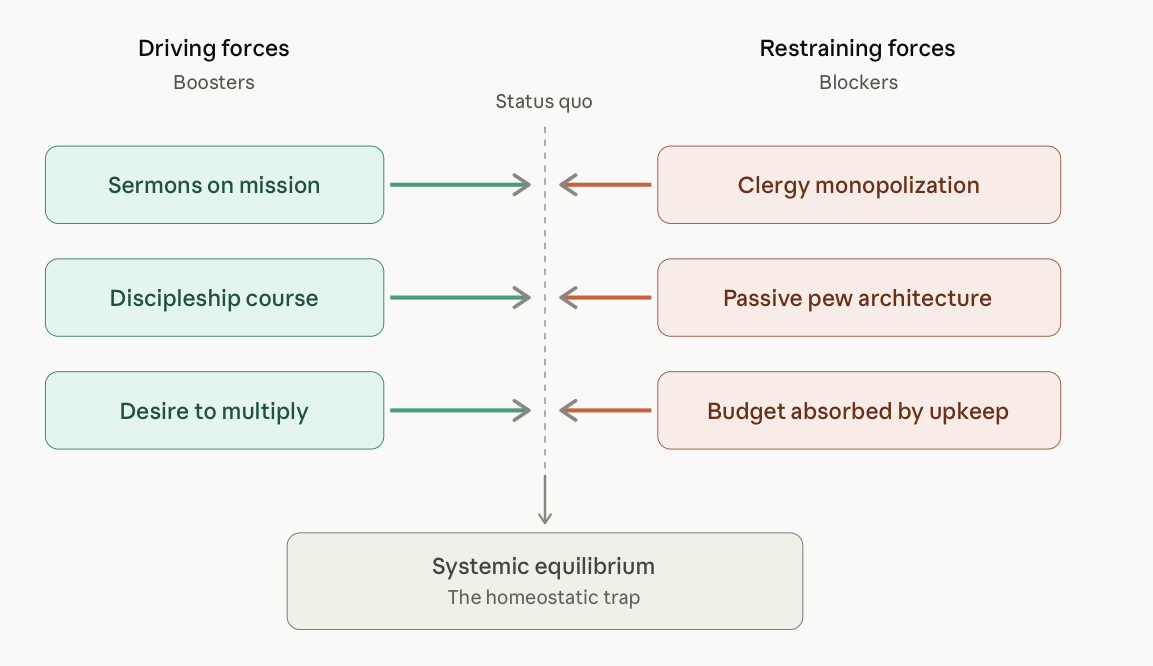
The Cancellation Dynamic: How Blockers Neutralize Boosters
The fundamental tragedy in the contemporary church is that its institutional structures actively cancel out its stated theology. As highlighted in Metanoia, if a congregation attempts to cultivate a missional, apostolic identity ("go to them"), yet 90% of its budget, staffing, physical architecture, and calendar are dedicated to maintaining an attractional Sunday spectacle ("come to us"), the "come-to-us-ness" of the system will systematically devour and cancel out the "go-to-them-ness" every single time. The institutional medium completely drowns out the verbal message.
To apply this diagnostic, I have here mapped the six elements of Movement DNA (mDNA) articulated in my seminal book The Forgotten Ways, to explore active Booste and embedded Blockers:
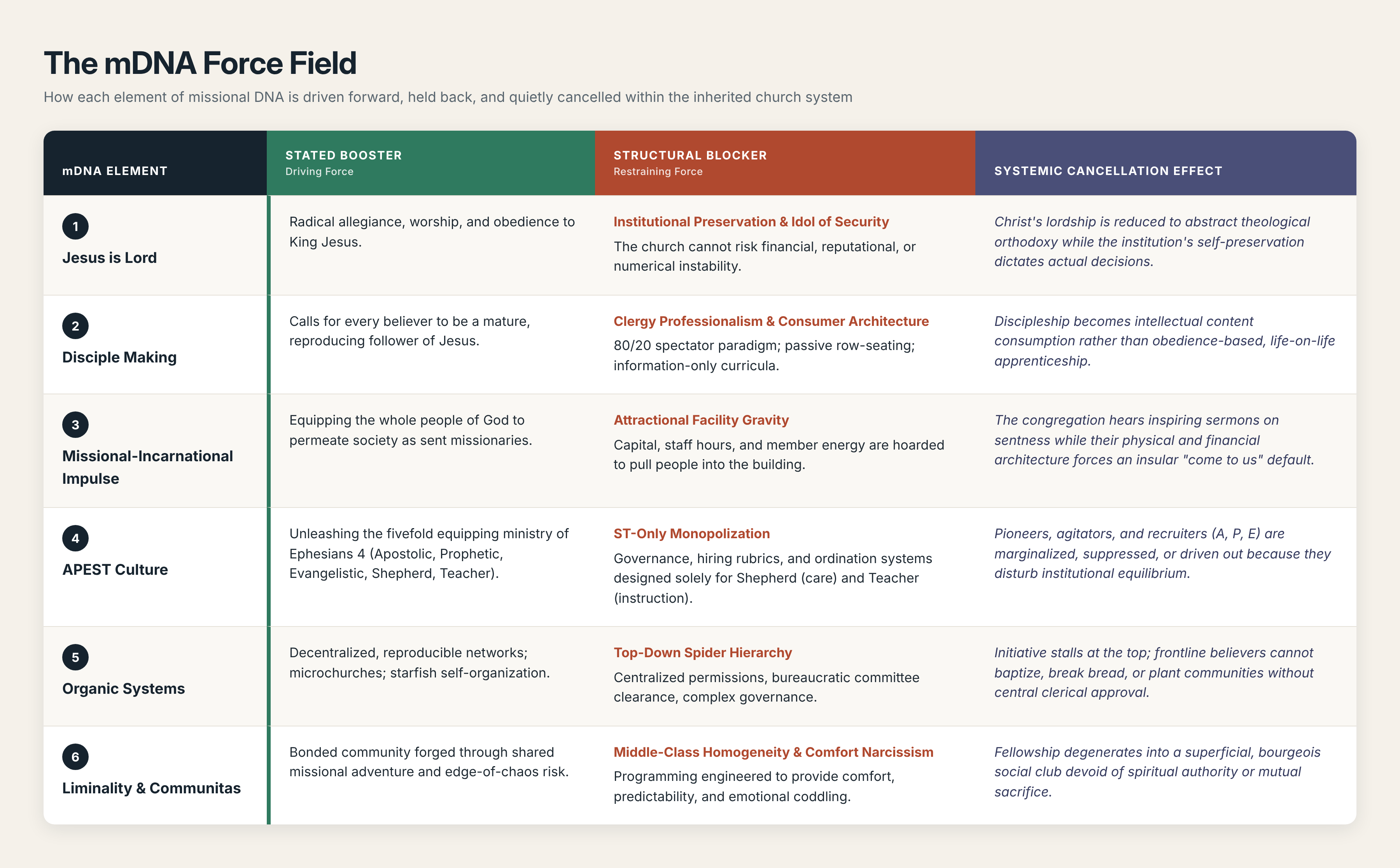
Executing a Force-Field Audit in Your Leadership Ecosystem
Phase 1: Uncover the "Hidden POSIWID" (The Systems Audit)
Cybernetician Stafford Beer famously stated that The Purpose of a System Is What It Does (POSIWID). Convene your core elders, staff, and frontline practitioners. Set aside your mission statement and doctrinal page, and examine what the system factually produces:
The Resource Balance: Pull your general ledger from the past 24 months. What percentage of every dollar is spent on maintaining internal programs and professional facilities versus funding decentralized frontline mission? If 85% goes to internal operations, your system's operational purpose is maintenance, not apostolic multiplication.
The Attention Economy: Review the weekly work hours of your staff and leaders. How many collective hours are dedicated to preparing the Sunday theatrical event versus coaching, mentoring, and releasing ordinary believers in everyday cultural spaces?
The Promotion Pipeline: Look at the leaders you celebrate and appoint. Are they chosen for compliance, institutional loyalty, and pastoral agreeableness, or are they apostolic entrepreneurs and prophetic dissenters who push the community beyond its comfort zone?
Phase 2: Identify the Balancing Loops (Systemic Dampers)
In systems dynamics, balancing feedback loops act like thermostats—they sense any deviation from the system's baseline and automatically initiate corrective actions to bring the temperature back to "normal".
Identify the Thermostat: What happens when an innovative leader in your community tries to plant an organic microchurch without traditional staff oversight or financial dependency? Does the administrative machine suddenly demand budget approval, curriculum vetting, and theological oversight?
Name the Immune Reaction: When true prophetic dissent surfaces regarding consumerism or racial and economic segregation, how does the system suppress it? As Peter Senge and Gareth Morgan note, when an organization's "psychic prison" is challenged, the system mobilizes defensiveness to protect its equilibrium.
Phase 3: Trace the Leverage Points
Donella Meadows outlined a hierarchy of twelve leverage points for intervening in a system, noting that the highest-leverage interventions are not mechanical parameters (such as tinkering with service times or curriculum), but rather changing the system's rules, its information flows, its goals, and ultimately the underlying paradigm:
Alter the Rules of Engagement (Meadows' Leverage Point #5):
Old Institutional Rule: Only ordained professionals can administer sacraments, teach the Bible authoritatively, and plant churches.
New Movement Rule: Every disciple has the Word, the Spirit, and the authority of the Great Commission to preach, baptize, celebrate the Lord’s Supper, and make reproducing disciples.
Restructure Information Flows (Meadows' Leverage Point #6):
Old Institutional Flow: All data, metrics, and communications flow upward to the senior pastor or executive board.
New Movement Flow: Transparent, peer-to-peer storytelling and field intelligence where frontline discoveries, triumphs, and failures are immediately shared laterally across the entire network.
Shift the Systemic Goal (Meadows' Leverage Point #3):
Old Institutional Goal: Maximize weekly Sunday attendance ("bums on seats"), build physical monuments, and expand corporate budget.
New Movement Goal: Maximize the density of reproducing disciples, microchurches, and kingdom outposts planted in every neighborhood and cultural sphere.
Phase 4: Shift from Maintenance to Movement Platform
Remember the core formula of organizational refounding that I set out in Metanoia: Platform = Culture + Structures. Structure and culture must be calibrated concurrently.
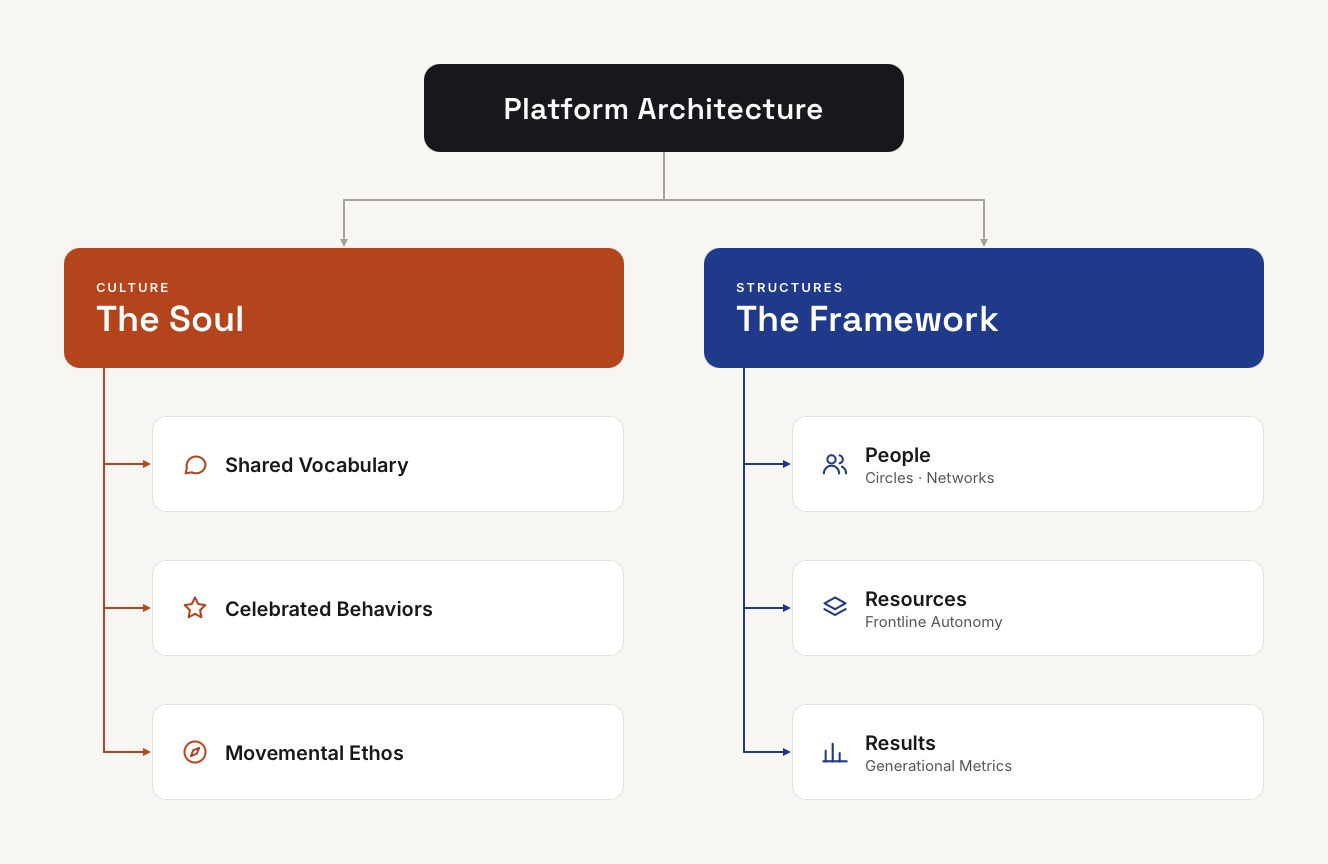
Rethink People Structures (Move from Pyramids to Circles): Replace hierarchical pyramids with decentralized, autonomous cell-based teams. Adopt Peter Block's structural axiom: "Change the room, change the culture."Remove the elevated stage and lecture rows; organize your leadership spaces as circles of co-learners and co-creators.
Rethink Resource Structures: Decentralize financial control. Implement a "tithe-back" mechanism where 20% to 50% of financial giving generated by micro-communities stays directly within their frontline contexts for local ministry, hospitality, and mercy, rather than being vacuumed up by central administration.
Rethink Results Structures (Change What You Measure): Stop celebrating gross attendance. Measure net multiplication:
How many disciples are reproducing to the third and fourth generation?
How many ordinary saints are actively utilizing their APEST gifts in their workplaces?
How many micro-communities have been planted without professional staff funding?
What to Do Next: Three Generative Experiments
Do not attempt to overhaul the entire institutional aircraft carrier overnight. In living-systems change, big changes emerge from small, high-leverage perturbations at the margins. As Myron Rogers framed it: "Start anywhere and follow it everywhere."
Establish a "Protected Incubator" on the Margin: Pick one apostolic pioneer in your community and give them total permission and legal coverage to build outside the standard attractional rubric. Shield them from institutional committee reporting, free them from Sunday morning service obligations, and commission them to plant a microchurch network directly among an unreached pocket of people in your city.
Run a Pulpit Fast: Declare a specific season where the platform shifts from monological sermons to participatory learning, testimony from the margins, and interactive scriptural engagement. Explicitly instruct the congregation: "The clergy will no longer do the ministry for you; you are the missionary agency of this neighborhood."
Conduct an APEST Calibration exercise: Take your key team away for a two-day offsite specifically to evaluate where the system has exiled the Apostolic, Prophetic, and Evangelistic callings. Give the A, P, and E voices the whiteboard and ask them: "If you had total permission to re-engineer our schedule and budget around frontline movement, what would we stop doing tomorrow?"
Before You Go >>
Consider becoming an active member here at alanhirsch.com. If you are any way familiar with my work, or want to engage and understand it, this platform will thrill you! Its in beta form right now (and its only going to get better and better), but it will host everything I have done and will do, including new writing, articles, online learning cohorts, highly trained AI agents that will help you integrate the ideas.
AND, I am hoping that this will become my primary way of funding my ministry. If you ever wanted to support me and my ministry, this is the place and the time