Jesus has given the church everything it needs to get the job done.
In brief
The Permanent Revolution (2012), written with Tim Catchim, gives the fivefold ministry of Ephesians 4 its full biblical and ecclesial treatment. Apostles, prophets, evangelists, shepherds and teachers are the ascended Christ's own ministry distributed into his body, so a church limited to shepherds and teachers runs on two cylinders of five. It names the apostolic as the catalytic function, traces the exile of the apostolic, prophetic and evangelistic, and insists that APEST belongs to the whole people of God.
On this page
The question that drives The Permanent Revolution is deceptively simple: what kind of ministry does Jesus actually give his church? Not what we have inherited, not what seventeen centuries of institutional Christianity have normalized — what did Jesus himself give?
The answer Paul gives in Ephesians 4 is fivefold. Apostles, prophets, evangelists, shepherds, and teachers — five distinct callings, five distinct intelligences, each one a different way of carrying the presence and mission of Christ into the world. And the argument of this book, developed in exhaustive biblical and theological detail with Tim Catchim, is that the Western church has been running on two of those five for so long that it has forgotten what the other three feel like.
That is not a minor oversight. It is a structural crisis.
§ 1
Why This Book Exists
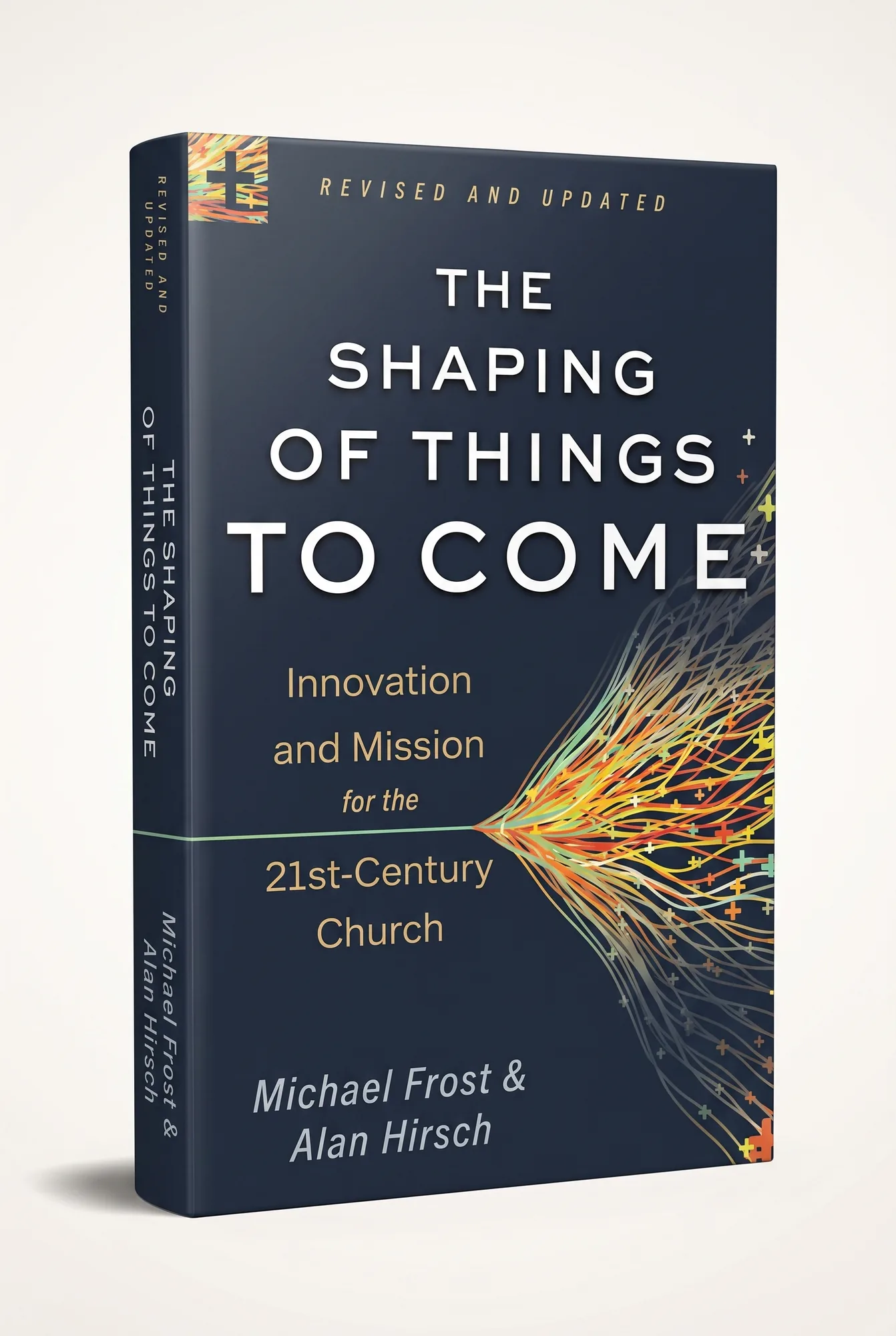
Across the first decade of the missional church movement, The Shaping of Things to Come (2003) and The Forgotten Ways (2006) had put APEST on the map. Thousands of leaders were beginning to recognize that Ephesians 4 held the key to dynamic movement dynamics.
Yet as the language spread, a significant gap emerged: there was no comprehensive, rigorous, book-length treatment of the fivefold ministry that addressed both its high Christological grounding and its granular organizational practice. Without a rigorous ecclesiological foundation, "APEST" was in danger of being treated as just another personality test — a spiritual Myers-Briggs for leadership teams — rather than the constitutive ministry architecture of the body of Christ.
Tim Catchim and I spent years researching, testing, and writing The Permanent Revolution to provide that definitive foundation. We wanted to rescue the apostolic from its authoritarian misreadings, demonstrate that all five callings are rooted in the ascension of Christ, and show how a church organized around the fivefold can break free from institutional stagnation.
§ 2
The Central Reframe: The Fivefold Fullness of Christ
The cascade arrives in The Permanent Revolution at its organizational conclusion: Christology shapes Missiology shapes Ecclesiology.
If Jesus is Lord — if his lordship is the first and governing reality — then his own ministry must determine the shape of the church's ministry. This is what Paul is arguing in Ephesians 4. Jesus operated in all five modes: apostolically, prophetically, evangelistically, pastorally, and as teacher. Having ascended, he did not retire those functions. He distributed them — gifted them, Paul says — into the Body: "Each one of us has been given a measure of gifting from Christ" (Ephesians 4:7). The fivefold is not a leadership typology Jesus suggested. It is the fullness of his own ministry, poured into the people who bear his name.
To operate with anything less than all five is to attempt to extend Jesus's ministry with less than Jesus's full capacity. And this, Hirsch and Catchim argue, is precisely what seventeen centuries of Christendom have accomplished. The shepherd-teacher monopoly is not a conspiracy. It is what happens when the catalytic apostolic function goes dormant — care and formation fill the vacuum, and they fill it well, but they cannot generate the outward-bound movement the church was built to be.
The book's title reaches back into the Reformed tradition — ecclesia reformata, semper reformanda (the church reformed, always reforming) — and applies it to ministry architecture. The church is not a settled institution that occasionally undergoes renewal. It is, by design, a permanent revolutionary movement whose built-in renewal mechanism is APEST. The apostle is literally given by Jesus to the ecclesia to drive the permanent revolution that the church was always meant to be.
§ 3
What the Book Actually Does
The Permanent Revolution maps the biblical, historical, theological, and practical terrain of the fivefold ministry.
The Engine Running on Two Cylinders
There is a phrase that gets at the problem with some precision: we have been trying to run a five-cylinder engine on two cylinders and wondering why it is not running well. The two cylinders we have kept are the shepherd and the teacher. These are the functions that the Christendom settlement selected for — and selected for with remarkable efficiency. When the world came to the church, when cultural pressure produced nominal Christianity, when the institution was the establishment, there was no structural need for the outward-facing functions.
So the Christendom arrangement selected for shepherds and teachers. It got them. And it got them at the expense of the apostolic, the prophetic, and the evangelistic — precisely the three functions that orient the community outward, toward the frontier, toward the lost, toward the places Jesus goes ahead of us.
The result is a church organizationally and culturally designed to achieve almost exclusively pastoral and educational outcomes. And then we are surprised when it does not generate movement. This is what I mean when I say the system is perfectly designed to produce the results it gets. We have not failed through lack of effort. We have succeeded — at producing exactly the kind of church our design calls for. A church that tends, gathers, teaches, and holds. A church that, in the post-Christendom landscape, has lost the capacity to go.
What Ephesians 4 Actually Says
The text itself is remarkable in its scope. Paul writes that Christ, having ascended far above all the heavens in order to fill all things, distributed gifts to his church — and the gifts he distributed were people. Not programs. Not structures. Not doctrines. People: apostles, prophets, evangelists, shepherds, teachers. Given, Paul says, for the equipping of the saints for works of ministry, for the building up of the body of Christ, until we all reach the unity of the faith and the knowledge of the Son of God — until we attain to the whole measure of the fullness of Christ (Eph. 4:11–13).
That last phrase carries the full weight of the argument. The goal is the fullness of Christ. The means is the fivefold ministry. The two are inseparable. You cannot attain to the fullness of Christ by suppressing three of the five means he gave to get there. The shepherd-teacher monopoly is a structural impediment to the church becoming what Christ intends it to be.
This is an argument about Christology before it is an argument about leadership structures. When Paul describes the fivefold ministry in Ephesians 4, he is describing five dimensions of Christ himself — five ways that the ascended Lord remains present and active in the world through his body:
- The apostle carries the pioneering, boundary-crossing, system-building dimension of Christ's own apostolic sending.
- The prophet carries the disruptive, truth-telling, covenant-calling dimension of Christ's prophetic identity.
- The evangelist carries the good-news-announcing, kingdom-proclaiming dimension of Christ's own proclamation.
- The shepherd carries the gathering, protecting, forming dimension of Christ's pastoral heart.
- The teacher carries the wisdom-mediating, revelation-interpreting dimension of Christ's own teaching office.
When we suppress any of these five, we suppress a dimension of Christ himself. When we recover all five, we recover a fuller image of the one who is all in all.
The Apostolic as Catalytic
The book gives particular attention to the apostolic function — and for good reason. Of all five callings, the apostolic is the one most misunderstood, most feared, and most necessary. It is the catalytic ministry: the one that, when present and functioning, creates the conditions for the other four to operate; the one that, when absent, leaves the whole system tending toward maintenance, toward the center, toward institutional self-preservation.
Think of it like a seed. The apostolic function carries the genetic code of the movement — the mDNA — and distributes it into new soil. The prophet grows from that soil as a call to faithfulness. The evangelist grows as a call to response. The shepherd grows as a gathering of those who respond. The teacher grows as the deepening of what has been gathered. Remove the seed and you have no growth — only the management of what was planted by someone else, in a season that has already passed.
The early church under Roman persecution is the clearest historical evidence for this. With no buildings, no centralized hierarchy, no state patronage, and no political protection, the Jesus movement grew from a few hundred in Jerusalem to an estimated twenty million across the Roman Empire within three centuries. The mechanism was not primarily the pastoral function. It was the apostolic: mobile, adaptive, pioneering, multiplying. The same pattern appears in the Chinese underground church under Mao — a movement that grew from roughly one million in 1949 to somewhere between eighty and one hundred million by the early 2000s, precisely because it was forced to operate in apostolic mode, without the institutional structures that normally suppress it.
These are not historical curiosities. They are the genetic record of what the church looks like when the full fivefold system is functioning. The apostolic function is the seed; the movement is the tree.
The Exiled Three
The apostolic, prophetic, and evangelistic functions have not disappeared from the church. They have been exiled from it.
Throughout the Christendom period, people carrying these callings existed — they were there. They simply were not given legitimacy or recognition within the institutional church. They were pushed to the margins, to the para-church organizations, to the edges of denominational life. The Navigators, Campus Crusade, World Vision, Youth for Christ — these organizations emerged precisely because the church was structured to exclude the functions they were carrying. The para-church was, in a very real sense, the exile community of the exiled three.
The recovery of the full fivefold ministry is a matter of recognizing what is already present — already functioning at the margins, already alive in the body — and giving it the legitimacy and the space to operate at the center.
The Latent Potential of the Whole Body
The book's second major contribution is its insistence that APEST is the ministry architecture of the whole people of God — every member, not a leadership tier.
Paul's language in Ephesians 4 is unambiguous: each one of us has been given a measure of gifting. The fivefold functions are latent in every member of the Body, in varying degrees and combinations. What the church has done — by concentrating ministry in a professional pastoral class — is suppress the apostolic, prophetic, and evangelistic intelligence that lives in the congregation itself. People who carry an apostolic instinct to pioneer, a prophetic instinct to name what is true, an evangelistic instinct to draw others toward Jesus — they sit in pews, week after week, with no language for what they carry and no structure to release it.
When communities begin to recover this, the first thing that shifts is imagination. People begin to understand themselves as carriers of a specific kind of intelligence the Body needs. That shift in self-understanding, before any structural change, begins to move the system. The organism starts to behave like an organism.
§ 4
Where This Book Sits in the Larger Body of Work
The Permanent Revolution represents the maturation of the APEST thesis that began in Chapter 10 of The Shaping of Things to Come (2003) and was framed as Element 4 of Apostolic Genius in The Forgotten Ways (2006).
Here, for the first time, APEST is given full biblical commentary, theological justification, and organizational development. It articulates the ecclesiological counterpart to the Christology established in ReJesus (2008).
Five years later, Alan would publish 5Q: Reactivating the Original Intelligence and Capacity of the Body of Christ (2017). Where The Permanent Revolution focuses primarily on apostolic leadership, ministry roles, and church structure, 5Q takes the framework to the cosmological and systemic level, showing how the fivefold functions as the archetypal DNA of all healthy human systems and organizational design. The Permanent Revolution remains the essential ecclesial text for understanding how fivefold ministry works in the local church.
§ 5
Who Needs to Read This
- The apostolic leader or church planterwho feels alienated by traditional pastoral job descriptions and needs theological validation for their pioneering, boundary-crossing wiring.
- The senior pastorwho feels burned out trying to be all five callings at once, and needs a theological pathway to share the burden of ministry across a multidimensional team.
- The prophetic or evangelistic Christianwho feels misunderstood or sidelined in an institutional church setting, looking for language to describe their calling.
- The denominational executive or seminary professorseeking a biblical, rigorous alternative to the Christendom shepherd-teacher paradigm.
§ 6
Where to Go Next
For readers who want to explore how the fivefold functions as a systemic, archetypal intelligence across the entire body of Christ and society, 5Q (2017) is the next step.
For those wanting to see how APEST sits within the broader ecosystem of viral movements, The Forgotten Ways (2006) shows how APEST operates alongside the other five elements of mDNA.
Sources
Sources drawn from
The Permanent Revolution (Hirsch & Catchim, Baker, 2012) — Introduction, "Missional Ministry for a Missional Church," "Better Together," "Living from the Center," "Custody of the Codes"; The Forgotten Ways (Hirsch, Baker, 2006/2016) — "APEST Culture," "Missional-Incarnational Impulse"; 5Q (Hirsch, 100M, 2017) — "RetroFuture," "Eph4Us," "Embodiment," "Hero's Journey"; APEST Five-Types Reference; APEST Misreads Handbook.
How these ideas evolved
Each concept in this book, and every book it runs through.
- APEST Culture
Develops here
- The Shaping of Things to Come (2003)
- The Forgotten Ways (2006)
- The Forgotten Ways Handbook (2009)
- On the Verge (2011)
- The Permanent Revolution (2012)
- 5Q (2017)
- Organic Systems
Develops here
- Jesus Is Lord
Develops here