“Show me your Jesus, and I'll tell you who you are.”
In brief
ReJesus (2008), written with Michael Frost, argues that the church's fundamental correction must be Christological. "Show me your Jesus, and I'll tell you who you are": the Western church has domesticated a manageable Jesus who endorses its institutions. The book develops a missional Christology — Christology for the road — and sets out the one-way cascade in which Christology shapes missiology and missiology shapes ecclesiology. It gives Element 1 of mDNA, Jesus Is Lord, its full theological development.
On this page
That single line from ReJesus carries the full weight of the book's argument. The Jesus we construct — the Jesus we preach, the Jesus we sing to, the Jesus we use to comfort ourselves and justify our institutions — reveals not so much who Jesus is as who we are. And the Western church, by almost any honest accounting, has constructed a Jesus it can manage. A Jesus who endorses its programs, baptizes its cultural preferences, and asks nothing that would require a fundamental disruption of the way things are.
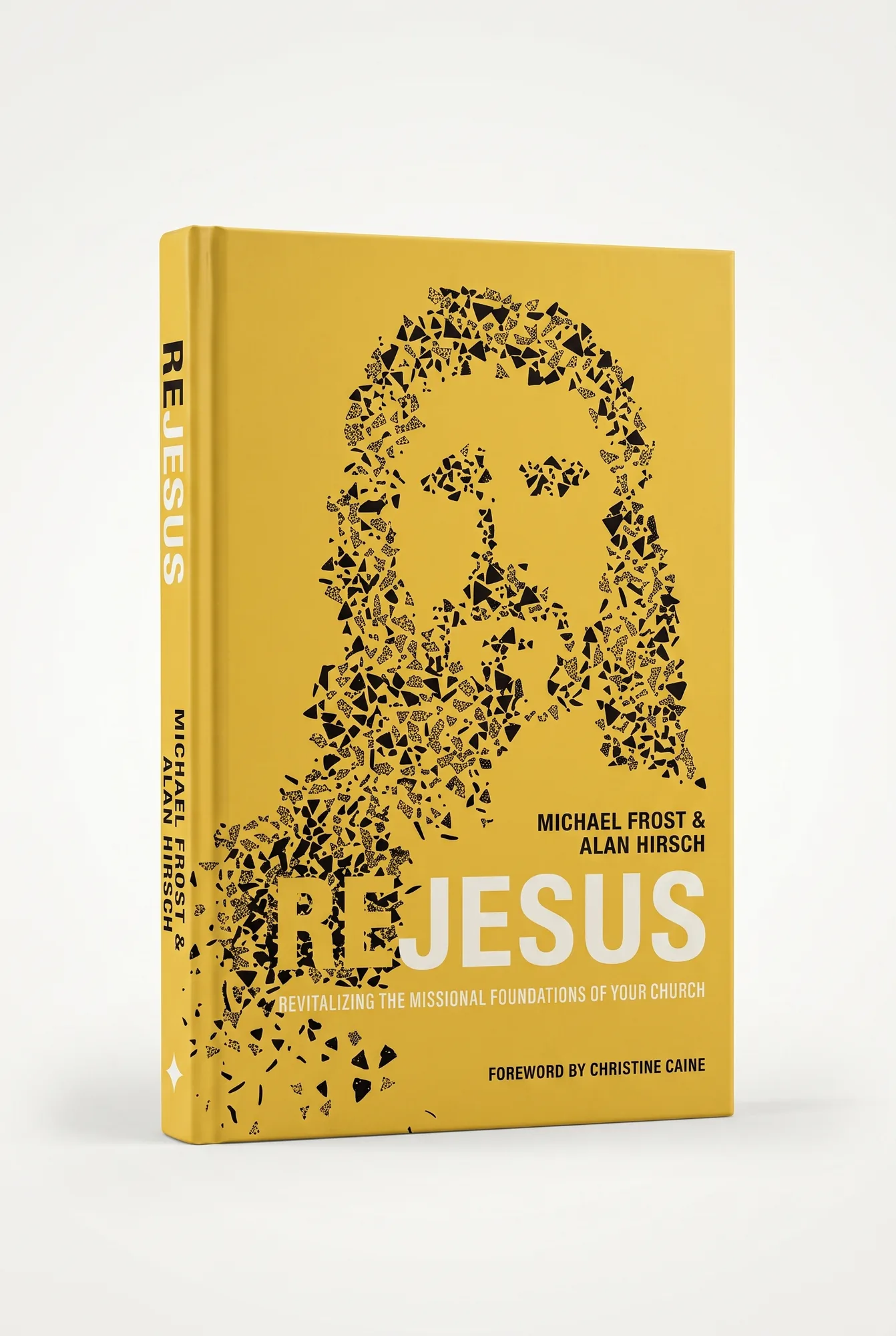
ReJesus, published in 2008 by Michael Frost and Alan Hirsch, is the sustained theological argument against that construction. It is a book about Christology — about who Jesus actually is, and what happens to a church, a community, and a life when that question is answered with full honesty.
The subtitle says it precisely: A Wild Messiah for a Missional Church. The wildness is theological, not rhetorical. It is the claim that the Jesus of the Gospels — homeless, propertyless, peripatetic, socially marginal, as Terry Eagleton describes him — cannot be contained by any institution, including the one that bears his name. Every attempt to domesticate him produces a distortion. And the distortions accumulate, quietly, over centuries, until the church finds itself worshipping a figure who looks remarkably like its own best self.
This is the problem ReJesus was written to name — and to undo.
§ 1
Why This Book Exists
By 2008, the missional church conversation was five years old. The Shaping of Things to Come had named the structural problem. The Forgotten Ways had provided the framework. A generation of church planters, denominational leaders, and theological students had begun the work of recovering incarnational, movemental, apostolic forms of church.
And then a question surfaced from within the conversation itself. Dan Kimball named it as directly as anyone: "How horrific it is to think that we could be so passionately missional, but subtly drift from being entirely Jesus-centric in the process."
That drift was real. The missional conversation had generated a new vocabulary — mDNA, incarnational, APEST, communitas — and with any new vocabulary comes the risk of the vocabulary becoming the center. The frameworks could be engaged, the strategies could be implemented, the language could be fluent — and Jesus could gradually migrate from living Lord to reference point.
ReJesus is the theological pressure applied against that migration. It insists, from its first page to its last, that Christology is the ground of everything — the source from which Missiology flows, and from which Ecclesiology is shaped. "We believe that the fundamental correction for the church at the dawn of the twenty-first century must be a christological one that will in turn revolutionize our missiology as well as our ecclesiology."1
The cascade runs in one direction only: Christology shapes Missiology shapes Ecclesiology. When the Christology is right — when the Jesus at the center is the actual Jesus of the Gospels — everything downstream takes on a different character. When the Christology drifts, everything downstream drifts with it. One degree off at launch, and you miss the destination by thousands of miles.2
§ 2
The Central Reframe: Missional Christology
The book's primary move is to insist that Christology is a living discipline, not merely an academic one. The introduction defines it as "the study and examination of the entire phenomenon of Jesus, including his person and work and teachings, for the purpose of determining in what ways the various elements of his life and activity can be emulated by sinful human beings."3
This is what the book calls missional Christology — Christology for the road, not just the classroom. What does the life of Jesus — his patterns of engagement, his social location, his way of teaching, his relationship to power, his practice of community — require of those who claim to follow him?
The answer the book develops is neither comfortable nor vague. Jesus was "loving, wildly passionate, dangerous, radically merciful, and always surprising."4 He was neither a therapist offering emotional comfort nor a social revolutionary in the Che Guevara mold. The book is precise about this: "In the correct sense of the terms, Jesus was probably more a reformer than a revolutionary. He wasn't committed to overturning the whole religious system of which he was part."5 He worked from within, through parable and paradox, through table fellowship and healing, through a life that subverted every system that tried to contain him — including the religious systems of his own day.
The church that takes this Jesus seriously will be organized differently, led differently, and present itself in the world differently. The ecclesiological implications flow directly from the Christological recovery. That is the book's structural logic, and it holds from the first chapter to the last.
§ 3
What the Book Actually Does
ReJesus moves through seven chapters, each building the Christological case from a different angle.
pp. 1–15
Introduction: "Read This Bit First"
Establishes the book's governing conviction: "any loss of a direct, grassroots comprehension of Jesus must be a major cause in the degeneration of Christianity in any time and any place."6 It names the project as missional Christology — an attempt to recalibrate the mission of the church around the person and work of Jesus.
Chapter 1
pp. 17–39
How Jesus Changes Everything
Opens the argument by demonstrating the scope of Jesus' claim. Drawing on Terry Eagleton's description of Jesus as "homeless, propertyless, peripatetic, socially marginal," and on Jacques Ellul's claim that early Christianity was "antireligion," the chapter argues that Jesus does not fit within any of the categories the world provides for him.7 He is the one who, as Matthew 13:24–30 suggests, lets wheat and weeds grow together rather than imposing premature order — a patient, subversive, world-transforming presence that works through apparent weakness rather than institutional power.
Chapter 2
pp. 41–61
ReJesus and Personal Renewal
Turns from diagnosis to formation. The chapter develops three great orientations of a Jesus-shaped life: missio Dei (participation in God's mission), participatio Christi (participation in Christ's own life), and imago Dei (the recovery of the image of God in human beings).8 Genuine renewal, the chapter argues, is always Christomorphic — shaped by the actual contours of Jesus' own life and spirituality. "From the fundamentalist co-option of Jesus as a religious fanatic to the liberal reduction of him into a schmaltzy moralist, it is probably fair to say that we have largely lost touch with our loving, wildly passionate, dangerous, radically merciful, and always surprising Redeemer-Lord."9 The recovery begins with encounter — a fresh, unmediated engagement with the Jesus of the Gospels.
Chapter 3
pp. 63–85
ReJesus for the Church and the Organization
Develops the ecclesiological implications. Drawing on Ellul's claim that early Christianity was "antireligion," the chapter argues that the church is always at risk of becoming a religion about Jesus rather than a movement of Jesus.10 Matthew 16:18 is the hinge text: "I will build my church, and the gates of hell will not prevail against it." The church belongs to Jesus. It is built by Jesus. Any structure, any leadership model, any program that places itself between the living Jesus and his people is a structural problem, regardless of its theological pedigree.
Chapter 4
pp. 87–111
I've Got a Picture of Jesus
The book's most searching chapter. It surveys the false portraits of Jesus the Western church has substituted for the real one — the "sentimental daddy-figure," the "bearded-lady Jesus," the "spooky Jesus," the "political revolutionary," the "therapeutic life-coach."11 Each portrait tells us something accurate about the community that produced it. N. T. Wright's warning is cited here with full force: "without the real human Jesus of Nazareth, we are at the mercy of anybody who tells us that 'Christ' is this, or that."12 "Show me your Jesus, and I'll tell you who you are."13
Chapter 5
pp. 113–139
The Shema Schema (One God, One Love)
The book's theological center of gravity. The Shema of Israel — "Hear, O Israel: The LORD our God, the LORD is one" (Deuteronomy 6:4–9) — is the organizing confession of the people of God, reframed by the early church around the cosmic lordship of Jesus Christ.14 The chapter develops what it calls existential monotheism — the lived reality of a life ordered entirely around the one God revealed in Jesus. "Monotheism, interpreted from within the biblical worldview, is the belief that the one God, Lord and Creator of all, has rightful claim to sovereignty over all that he has created."15 The Shema Schema is the integrative center of discipleship: love God with everything — heart, soul, mind, strength — and love neighbor as self. These are one movement, with Jesus as its source and its shape.
Chapter 6
pp. 141–163
Three Two One... Engage
Addresses the epistemological question: how do we actually come to know this Jesus? The Western church's Hellenistic inheritance has distorted its capacity for genuine encounter with Christ — privileging speculative and philosophical knowing over the Hebraic knowing-through-engagement that the New Testament assumes.16 Drawing on Ephesians 3:17–19 and the Johannine "abiding" language of John 15, the chapter argues that knowing Jesus is a participatory, embodied, relational event — not a set of propositions to be mastered but a life to be inhabited.17 The chapter develops three modes of knowing: knowing about Jesus (cognitive), knowing Jesus (relational), and knowing through Jesus (participatory) — and argues that the Western church has heavily over-invested in the first at the expense of the second and third.18
Chapter 7
pp. 165–185
Reactivating the Jesus Heresy
Closes the book with its most prophetic argument. Early Christianity was, from the perspective of the Roman world and the Jewish establishment alike, a heresy — a dangerous, destabilizing movement organized around an executed criminal whom his followers claimed was alive and Lord of the cosmos.19 The chapter draws on Jacques Ellul's claim that "wherever Christianity has been adopted by a civilization as its religion, the result has been the death of that Christianity" — not as a counsel of despair but as a diagnostic.20 The institutional capture of Christianity by Christendom did not kill the movement permanently; it drove it underground, into the margins, into the communities of the poor and the persecuted, where it continued to generate the same explosive life it had always generated. The book's closing challenge is this: the reactivation of Apostolic Genius requires the recovery of Jesus — the actual, wild, uncontainable Jesus — as the living center of everything the church is and does.21
§ 4
Where This Book Sits in the Larger Body of Work
ReJesus occupies a specific and structurally essential position in the series: it is the Christological ground beneath everything else.
The Forgotten Ways named Element 1 of mDNA as "Jesus Is Lord" — the theological center of gravity of every authentic Jesus movement. But the treatment there was necessarily compressed, embedded within a larger framework. ReJesus gives that element its full theological development. It is, in one sense, the extended treatment of mDNA Element 1 — the book that asks: what does it actually mean to say "Jesus is Lord," and what does a community look like when it means it with full seriousness?
The cascade logic the book establishes — Christology shapes Missiology shapes Ecclesiology — is the structural logic of the entire body of work. The Shaping of Things to Come worked primarily at the Ecclesiology level, asking what a missional church looks like. The Forgotten Ways worked primarily at the Missiology level, asking what a missional movement requires. ReJesus goes to the root: it works at the Christology level, asking who Jesus actually is and what that requires of everything downstream.
Every subsequent book in the series assumes this Christological ground. Untamed (2010) develops the discipleship implications of a Jesus-shaped life. The Permanent Revolution (2012) grounds the APEST typology in the ascended Christ of Ephesians 4. ReFramation (2018) returns to the epistemological question of how we see God, the world, and mission — and the answer runs through Jesus. Metanoia (2023) grounds the renovation of imagination in the lordship of Christ.
ReJesus is the theological foundation. Everything else is built on it.
§ 5
Who Needs to Read This
- The missional church leaderwho has been deeply engaged with the frameworks — mDNA, APEST, incarnational community — and has begun to sense that the frameworks themselves can become the center. This book names that drift and provides the theological correction.
- The pastorwho has watched their congregation become fluent in Christian vocabulary while remaining largely unchanged in the texture of their daily lives. The gap between theological knowledge and genuine transformation is precisely the gap ReJesus addresses.
- The theologian or seminary studentwho wants the most developed account of missional Christology available in contemporary theological literature. The engagement with Eagleton, Ellul, N. T. Wright, and von Balthasar across the book's seven chapters is serious, sustained, and genuinely original.
- The ordinary follower of Jesuswho has a nagging sense that the Jesus they encounter in the Gospels and the Jesus they encounter in their church are not quite the same person. That sense is correct. This book explains why, and points toward the recovery.
- The church planterbuilding something new who wants to ensure that Jesus — the actual Jesus, not a manageable version — is genuinely at the center from the beginning. The book is a diagnostic tool for that work, and it is most useful before the institutional habits set in.
§ 6
Where to Go Next
ReJesus is the Christological root. Untamed (2010, with Debra Hirsch) is the natural next step — it develops the discipleship implications of a Jesus-shaped life into a full theology and practice of following Jesus in the way of the Gospels.
For those who want to go deeper on the Shema Schema — the integrative confession that organizes everything around the lordship of Jesus — The Forgotten Ways (2006) develops that same confession as the first and foundational element of mDNA, and shows how it functions as the animating center of every authentic Jesus movement in history.
The Jesus recovered in this book is the Jesus every other book in this series assumes. Start here, and everything else comes into sharper focus.
Notes
21 notes · 8 direct quotations
- QuotedDirect quotation: ReJesus, Introduction, p. 12. ↩
- The Christology → Missiology → Ecclesiology cascade: ReJesus, Introduction, pp. 12–15. ↩
- Definition of missional Christology: ReJesus, Introduction, p. 4. ↩
- QuotedDirect quotation: ReJesus, ch. 2, p. 43. ↩
- QuotedDirect quotation on Jesus as reformer rather than revolutionary: ReJesus, ch. 1, p. 28. ↩
- QuotedDirect quotation: ReJesus, Introduction, p. 1. ↩
- Terry Eagleton and Jacques Ellul on Jesus and anti-religion: ReJesus, ch. 1, pp. 17–24. ↩
- Missio Dei, participatio Christi, and imago Dei: ReJesus, ch. 2, pp. 41–55. ↩
- QuotedDirect quotation: ReJesus, ch. 2, p. 43. ↩
- Ellul on the danger of religion about Jesus: ReJesus, ch. 3, pp. 63–75. ↩
- The catalogue of cultural Jesus projections: ReJesus, ch. 4, pp. 87–105. ↩
- QuotedDirect quotation citing N.T. Wright: ReJesus, ch. 4, p. 92. ↩
- QuotedDirect quotation: ReJesus, ch. 4, p. 87. ↩
- The Shema of Deuteronomy 6:4–9 and cosmic Christology: ReJesus, ch. 5, pp. 113–128. ↩
- QuotedDirect quotation on existential monotheism: ReJesus, ch. 5, p. 115. ↩
- Hellenistic vs. Hebraic epistemology: ReJesus, ch. 6, pp. 141–150. ↩
- Ephesians 3:17–19 and Johannine abiding language as scriptural ground for participatory knowing: ReJesus, ch. 6, p. 141. ↩
- The three modes of knowing (about, relational, through): ReJesus, ch. 6, pp. 145–158. ↩
- Early Christianity as "heresy" from the perspective of Rome and Jewish establishment: ReJesus, ch. 7, p. 165. ↩
- Jacques Ellul's claim on Christianity and civilization: ReJesus, ch. 7, p. 165. ↩
- The closing challenge — reactivation of Apostolic Genius through recovery of the living Jesus: ReJesus, ch. 7, p. 185. ↩
Works cited
Built from the notes · details from the books record
Hirsch, Alan, and Michael Frost. ReJesus: A Wild Messiah for a Missional Church. Hendrickson Publishers, 2008.
this book · cited 21× · notes 1, 2, 3, 4, 5, 6, 7, 8, 9, 10, 11, 12, 13, 14, 15, 16, 17, 18, 19, 20, 21
Sources drawn from
ReJesus (all chapters: "Read This Bit First," "How Jesus Changes Everything," "ReJesus and Personal Renewal," "ReJesus for the Church and the Organization," "I've Got a Picture of Jesus," "The Shema Schema," "Three Two One... Engage," "Reactivating the Jesus Heresy"); The Forgotten Ways (Jesus Is Lord: Christological Monotheism); The Shaping of Things to Come (The God of Israel and the Renewal of Christianity); The Permanent Revolution (The Ascension and Ministry of Jesus).
How these ideas evolved
Each concept in this book, and every book it runs through.
- Jesus Is Lord
Develops here
- Disciple Making
Develops here
- Missional-Incarnational Impulse
Develops here
Related works
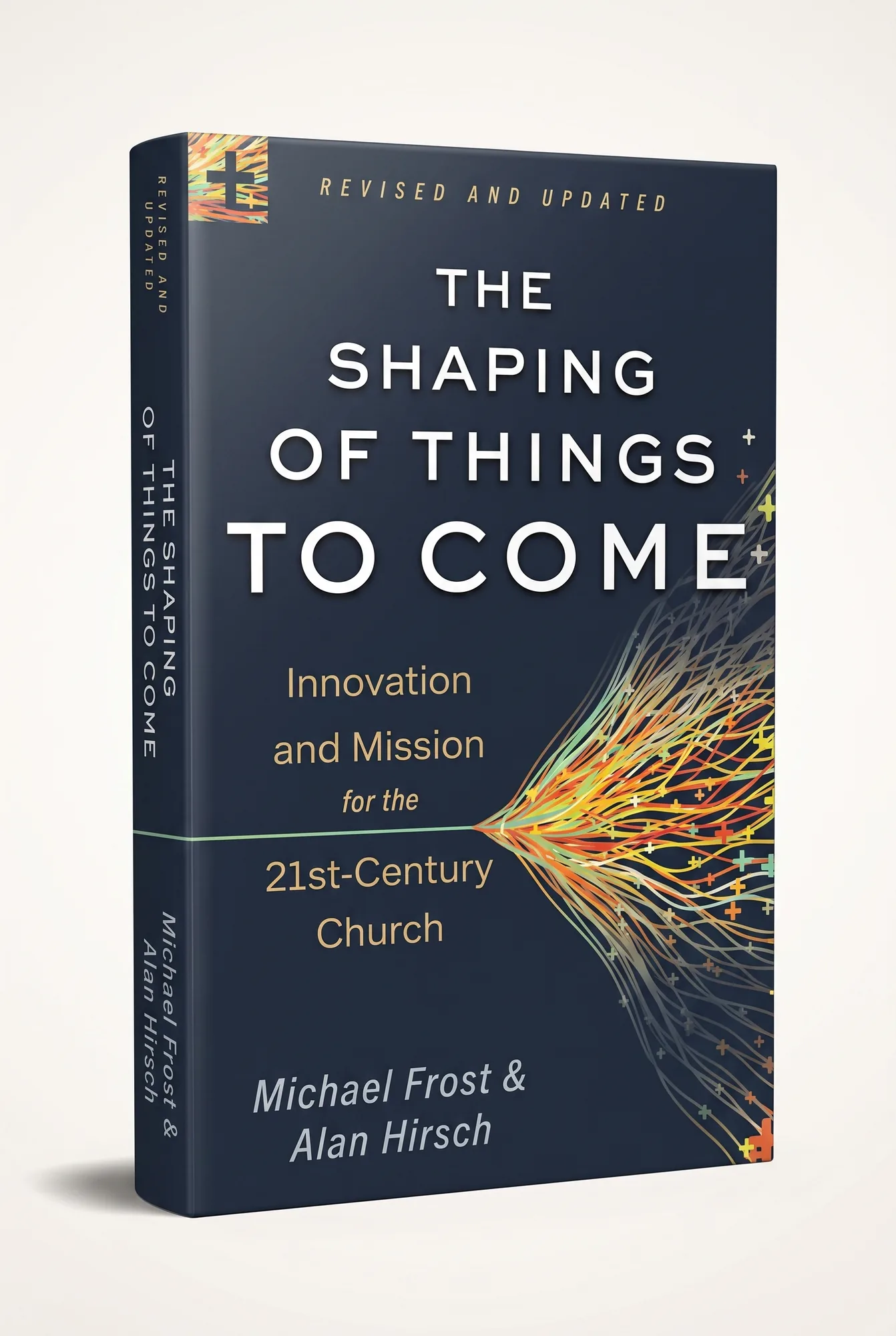
- 01 · 2003The Shaping of Things to ComeShares: Missional-Incarnational Impulse
- 02 · 2006The Forgotten WaysShares: Jesus Is Lord, Disciple Making, Missional-Incarnational Impulse

- 05 · 2010UntamedShares: Disciple Making, Jesus Is Lord, Missional-Incarnational Impulse

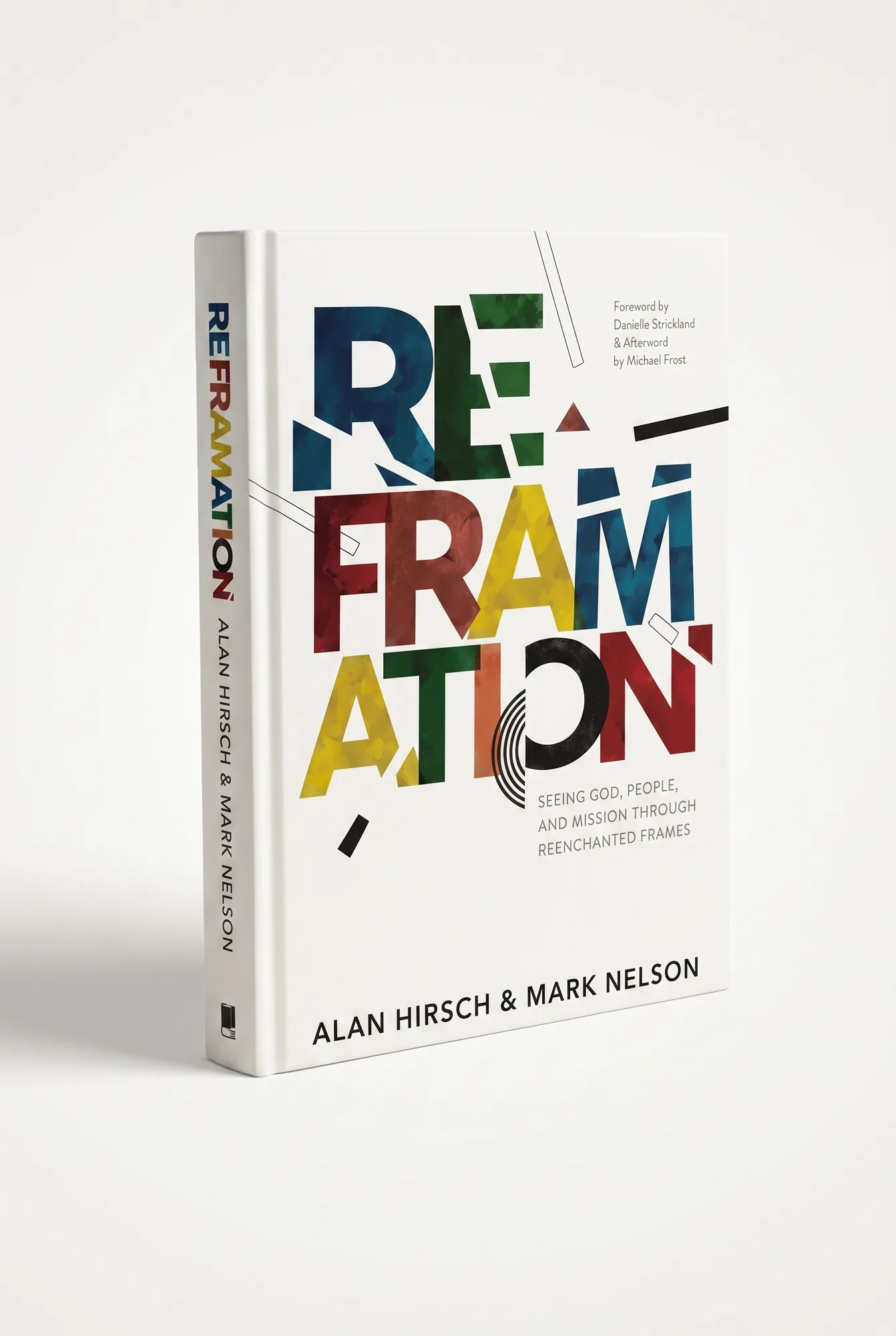
- 13 · 2018ReframationShares: Jesus Is Lord, Missional-Incarnational Impulse