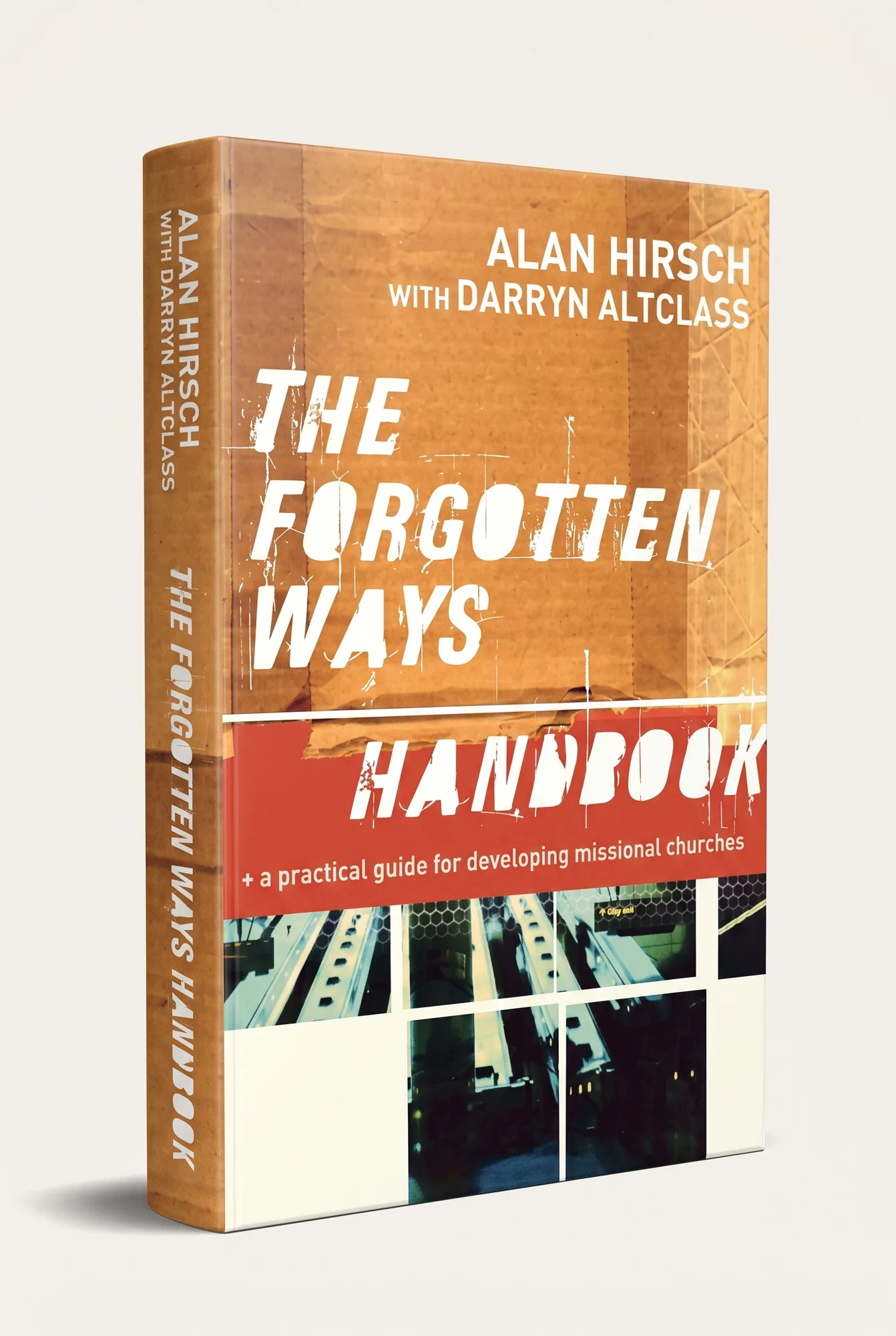
In writing The Forgotten Ways, I never intended to develop a missional technique, but rather to awaken a lost imagination. This workbook is not meant to short-circuit that much-needed recalibration, but rather to 'operationalize' it.
In brief
The Forgotten Ways Handbook (2009), written with Darryn Altclass, is the practitioner's companion to The Forgotten Ways. It turns the six elements of mDNA into practices, group sessions and diagnostics, drawing on Third Place Communities in Hobart and other missional networks. Its core method is simple: identify a community's weakest element, focus effort there, then move to the next — while treating no element as a silver bullet. It closes the gap between a recovered imagination and a changed community.
On this page
The Forgotten Ways awakened the imagination. This book asks what you do with it on Monday.
That is the precise problem the Handbook was written to solve. Within fifteen months of The Forgotten Ways being published, the most common response arriving by letter, email, and in person was some version of the same question: "I resonate deeply with the vision — but how do I actually begin?" The gap between a recovered imagination and a changed community is real, and it is not crossed by enthusiasm alone. It requires a different kind of tool — one that can take the theoretical architecture of mDNA and make it workable in the hands of an ordinary leader in an ordinary church.1
This is that tool.
§ 1
Why This Book Exists
The Handbook emerged from a recognition that The Forgotten Ways had done something it was designed to do — awaken what the preface calls a "lost imagination" — and had also surfaced something it could not do alone: provide the practical scaffolding for communities trying to move from resonance to action. "In writing The Forgotten Ways," the preface states plainly, "I never intended to develop a missional technique, but rather to awaken a lost imagination. This workbook is not meant to short-circuit that much-needed recalibration, but rather to 'operationalize' it."2
To write it, I needed a collaborator who had actually lived the theory. Darryn Altclass — a long-time friend and colleague, a church planter who had worked with me in the Forge Mission Training Network — had spent years implementing the mDNA framework in real communities. He had cofounded Third Place Communities (TPC), a network of missional communities embedded in the social rhythms of Hobart, Australia, whose members had rented apartments within a short walk of a local pub, organized their common life around households and tribes, and asked a single orienting question of their shared practice: "What is God brewing within, amongst, and around us?"3 TPC became the primary test case running through the book — chosen not because it was a superior example, but because we had both traveled with it closely enough to know its failures as well as its fruitfulness.4
The result is a book that sits in a particular and important genre: the practitioner's companion to a major theological work. It is not a substitute for The Forgotten Ways. It is the field guide you carry once you've read the map.
§ 2
The Central Reframe: Theory Is the Beginning, Not the End
There is a temptation, when engaging a framework as comprehensive as mDNA, to treat the intellectual grasp of it as the achievement. To understand Apostolic Genius is genuinely significant — it reorients the imagination, reopens questions, recovers a lost vocabulary. But understanding is the beginning of the journey, and the Handbook is insistent about this.
The central reframe the book offers is this: the goal of engaging with mDNA is not comprehension but activation. Apostolic Genius is latent in every authentic expression of the church — it is already there, coded into the DNA of every community that follows Jesus — and the task is not to acquire it from outside but to create the conditions under which it can blaze into reality. "Apostolic Genius lies dormant in you, me, and every local church that seeks to follow Jesus faithfully in any time. We have quite simply forgotten how to access and trigger it."5
The Handbook is a set of tools for triggering it.
Critically, the book is honest about what those tools can and cannot do. The scope of change required to shift a community toward genuine movement dynamics is "nothing less than paradigmatic."6 Every element of mDNA poses a direct challenge to the prevailing ways of doing church. The Handbook does not soften that challenge — it names it, and then provides a structured path through it. The realism here is pastoral and important: "The churches and organizations we inhabit will to some degree always be hybrids — a mixture of organic and institutional elements. The challenge for most of us will be to continually move toward being more movemental."7
§ 3
What the Book Actually Does
The Handbook is organized around the same six elements of mDNA that structure The Forgotten Ways, giving each element its own chapter with a consistent internal architecture: a summary of the element's theological content, a set of concrete practices, a real-world example from Third Place Communities or another missional network, and group processing sessions designed for teams working through the material together.
"A Note to Leaders" (pp. 8–18) opens the book with eight principles for using the mDNA framework as a strategic tool. These are worth naming in full, because they establish the posture the entire book requires.
First: engage the whole community in the process, not just the leadership team, because mDNA is embedded in the "stem cells" of a community — what gets built into the DNA at the foundational level shapes everything that follows.8 Second: think long-term. The scope of the change is paradigmatic; short-term solutions applied to complex problems produce cosmetic results. Third: think systems. mDNA is not a menu of independent options — it is an interrelated system in which each element reinforces and requires the others. Fourth: use the Apostolic Genius typology as a strategic diagnostic. Identify the weakest element, focus effort there, then move to the next weakest. "We suggest that the weakest element of mDNA then becomes the focus of strategic effort for that organization. Once that is developed over time, then the same process is undertaken to identify the next-weakest element."9 Fifth: resist the silver-bullet temptation. "Do not succumb to the temptation to treat any of the mDNA elements within itself as some sort of silver bullet, a quick cure for the ailments of your church. It takes all six to create an apostolic movement. Each is necessary but not sufficient."10
The six element chapters follow this diagnostic arc through the full mDNA system:
- The Jesus Is Lord chapter (pp. 19–50)grounds the entire framework in its theological center of gravity — the Shema of Israel (Deuteronomy 6:4–9) reframed around the cosmic lordship of Jesus Christ — and provides concrete practices for keeping Jesus genuinely central rather than nominally so. TPC's practice of cycling through the Gospels annually, and their organizing question "What is Jesus brewing within, amongst, and around us?", are offered as examples of how a community embeds its confession into its common rhythms rather than leaving it as an abstract statement of belief.11
- The Disciple Making chapter (pp. 51–80)develops the rabbi-apprentice pattern of formation — proximity, imitation, obedience — and provides practices for embedding it into the daily texture of community life. The chapter draws on InnerCHANGE's six discipleship commitments (humility, simplicity, purity, service, community, prayer) and Mosaic's four minimum standards of involvement as concrete examples of how discipleship norms get built into community architecture rather than left to individual initiative.12
- The Missional-Incarnational Impulse chapter (pp. 81–110)works through the outward and downward movements of incarnational mission — the impulse that drives the people of God into the fabric of their neighborhoods and subcultures. The chapter is rich with concrete practices: meeting in third places rather than church buildings, walking the neighborhood regularly, joining community groups, developing proximity through shared geography. InnerCHANGE's commitment to spending 80 percent of their time in the local neighborhood is cited as a benchmark of genuine incarnational proximity.13
- The Apostolic Environment chapter (pp. 98–121)develops what the second edition of The Forgotten Ways would name APEST Culture — the environment in which all five ministry functions of Ephesians 4 are genuinely active and mutually accountable. The chapter provides a framework for organizing a community around APEST functions, mapping the gifts present in a leadership team, and creating the structural conditions for apostolic influence to operate at the center rather than the margins.14 TPC's process of mapping their leadership team's APEST profile, hosting a community retreat to reflect on the results, and restructuring their missional rhythms accordingly is offered as a worked example of what this looks like in practice.15
- The Organic Systems chapter (pp. 122–145)addresses organizational structure for metabolic growth. TPC's three-tier structure — Households (gatherings of up to twenty people, meeting three times monthly), Tribes (the full network, gathering formally once monthly), and Clans (the broader network of connected Tribes) — is the primary structural example: simple enough to reproduce, networked enough to scale, and decentralized enough that no single node's removal collapses the whole.16
- The Communitas chapter (pp. 146–167)recovers Victor Turner's anthropological concept of the community that forms in the crucible of shared ordeal and shared mission. "The most vigorous forms of community are those that come together in the context of a shared ordeal. Communitas emerges from communities who define themselves as a group with a mission that lies beyond them, thus initiating a risky journey."17 The practical habits here are oriented toward creating the conditions for communitas — developing a daring missional vision, getting involved in shared endeavors alongside the host community, putting adventure back into the venture.
- "Resources" (pp. 168–178)closes the book with a collection of examples — discipleship norms, community mission practices, and structural models from TPC, InnerCHANGE, Small Boat Big Sea, Upstream Communities, and others — serving as a reference library for communities building their own common life.
§ 4
Where This Book Sits in the Larger Body of Work
The Forgotten Ways Handbook occupies a specific and irreplaceable position in the series: it is the bridge between the theoretical architecture of The Forgotten Ways and the lived practice of communities trying to embody it.
It does not advance the argument of The Forgotten Ways — that work was complete. It applies it. And in the application, it provides something the flagship text could not: the texture of what mDNA looks like when it is actually being worked out in households, pubs, neighborhoods, and leadership team retreats.
The Handbook also establishes the diagnostic framework that would be developed further in On the Verge (2011), where the mDNA system is embedded at the center of the "Verge church" process and applied to the question of organizational transformation at scale. Where the Handbook works primarily at the level of the local missional community, On the Verge works at the level of the church network and denomination.
For those who have read The Forgotten Ways and feel the gap between vision and action, this is the book that closes it.
§ 5
Who Needs to Read This
- The small group leaderwho has read The Forgotten Ways, resonated deeply, and returned to their community with a recovered imagination but no clear next step. The Handbook is structured precisely for group use — its processing sessions are designed to be worked through together, not alone.
- The church planterwho wants to build mDNA into the "stem cells" of a new community from the beginning, before institutional habits set in. The Handbook's advice here is direct: it is far easier to embed Apostolic Genius at the founding stage than to dislodge inherited imagination later.18
- The established church leadertrying to navigate the paradigmatic scope of the change required to shift a community toward genuine movement dynamics. The Handbook's hybrid realism — its honest acknowledgment that existing communities will always be mixtures of organic and institutional elements — is pastorally important. The journey is real and the destination is reachable; the Handbook is honest about both.
- The denominational coach or consultantworking with multiple communities at different stages of the mDNA journey. The diagnostic framework — identify the weakest element, focus effort there, move sequentially — is the most practically useful tool in the book for anyone working at a systems level across multiple communities.
§ 6
Where to Go Next
The Forgotten Ways Handbook is a bridge book. It assumes you have read The Forgotten Ways — if you haven't, start there.
Once the mDNA framework is alive in your community's practice, On the Verge (2011, with Dave Ferguson) is the natural next step for leaders working at the organizational and network level. It embeds the same framework in a comprehensive process for shifting existing church structures toward movement dynamics.
For those who want to go deeper on the APEST Culture element specifically — the element that addresses how ministry is organized and expressed — 5Q (2017) provides the most developed treatment available.
The Handbook is the field guide. The map is The Forgotten Ways. The expedition is your own.
Notes
18 notes · 7 direct quotations
- The context of the book's origin — fifteen months following publication of The Forgotten Ways: The Forgotten Ways Handbook, "Preface," pp. 6–7. ↩
- QuotedDirect quotation: The Forgotten Ways Handbook, "Preface," p. 6. ↩
- Third Place Communities' organizing question and proximity to the local pub: The Forgotten Ways Handbook, "Resources," pp. 168–178; The Forgotten Ways, Appendix 3. ↩
- TPC as primary test case, chosen for familiarity: The Forgotten Ways Handbook, "Preface," p. 7. ↩
- QuotedDirect quotation citing The Forgotten Ways, ch. 3: The Forgotten Ways Handbook, "Introduction to the Forgotten Ways.". ↩
- QuotedDirect quotation: The Forgotten Ways Handbook, "A Note to Leaders," p. 8. ↩
- QuotedDirect quotation: The Forgotten Ways Handbook, "A Note to Leaders," p. 18. ↩
- The "stem cells" metaphor for foundational community DNA: The Forgotten Ways Handbook, "Preface," p. 7. ↩
- QuotedDirect quotation: The Forgotten Ways Handbook, "A Note to Leaders," p. 14. ↩
- QuotedDirect quotation: The Forgotten Ways Handbook, "A Note to Leaders," p. 15. ↩
- TPC's Gospel-cycling practice and the "What is Jesus brewing?" question: The Forgotten Ways Handbook, "The Heart of It All," ch. 3, pp. 19–50. ↩
- InnerCHANGE's six commitments and Mosaic's four minimum standards: The Forgotten Ways Handbook, "Resources," pp. 168–178. ↩
- InnerCHANGE's 80 percent proximity commitment: The Forgotten Ways Handbook, "Missional-Incarnational Impulse," ch. 4, pp. 81–110. ↩
- Apostolic Environment and APEST Culture: The Forgotten Ways Handbook, "Apostolic Environment," pp. 98–121. ↩
- TPC's APEST mapping process and leadership retreat: The Forgotten Ways Handbook, "Apostolic Environment," pp. 98–121. ↩
- TPC's three-tier Household / Tribe / Clan structure: The Forgotten Ways Handbook, "Organic Systems," pp. 122–145. ↩
- QuotedDirect quotation on communitas and Victor Turner: The Forgotten Ways Handbook, "Communitas (Not Community)," pp. 146–167. ↩
- The importance of embedding mDNA at the founding stage: The Forgotten Ways Handbook, "Preface," p. 7. ↩
Works cited
Built from the notes · details from the books record
Hirsch, Alan. The Forgotten Ways Handbook: A Field Guide for Missional Assessment and Transformation. Brazos Press, 2009.
this book · cited 18× · notes 1, 2, 3, 4, 5, 6, 7, 8, 9, 10, 11, 12, 13, 14, 15, 16, 17, 18Hirsch, Alan. The Forgotten Ways: Reactivating Apostolic Movements. Brazos Press, 2006.
cited 1× · note 3
Sources drawn from
The Forgotten Ways Handbook (all chapters: "Preface," "A Note to Leaders," "Introduction to the Forgotten Ways," "The Heart of It All," "Disciple Making," "Missional-Incarnational Impulse," "Apostolic Environment," "Organic Systems," "Communitas," "Resources"); The Forgotten Ways (Appendix 3: A Living Example of Incarnational Church; Liminality and Communitas; APEST Culture); The Shaping of Things to Come (The Shape of the Missional Church).
How these ideas evolved
Each concept in this book, and every book it runs through.
- Jesus Is Lord
Applies here
- Disciple Making
Applies here
- Missional-Incarnational Impulse
Applies here
- APEST Culture
Applies here
- The Shaping of Things to Come (2003)
- The Forgotten Ways (2006)
- The Forgotten Ways Handbook (2009)
- On the Verge (2011)
- The Permanent Revolution (2012)
- 5Q (2017)
- Organic Systems
Applies here
- Liminality & Communitas
Applies here
- The Forgotten Ways (2006)
- The Forgotten Ways Handbook (2009)
- The Faith of Leap (2011)
- Missional DNA (mDNA)
Applies here
- The Forgotten Ways (2006)
- The Forgotten Ways Handbook (2009)
- On the Verge (2011)
- Apostolic Genius
Applies here
- The Forgotten Ways (2006)
- The Forgotten Ways Handbook (2009)
- On the Verge (2011)
Related works
- 02 · 2006The Forgotten WaysShares: Jesus Is Lord, Disciple Making, Missional-Incarnational Impulse, APEST Culture, Organic Systems, Liminality & Communitas, Missional DNA (mDNA), Apostolic Genius

- 09 · 2011On the VergeShares: Organic Systems, APEST Culture, Jesus Is Lord, Missional DNA (mDNA), Apostolic Genius

- 12 · 20175QShares: APEST Culture, Organic Systems, Jesus Is Lord
- 04 · 2008ReJesusShares: Jesus Is Lord, Disciple Making, Missional-Incarnational Impulse