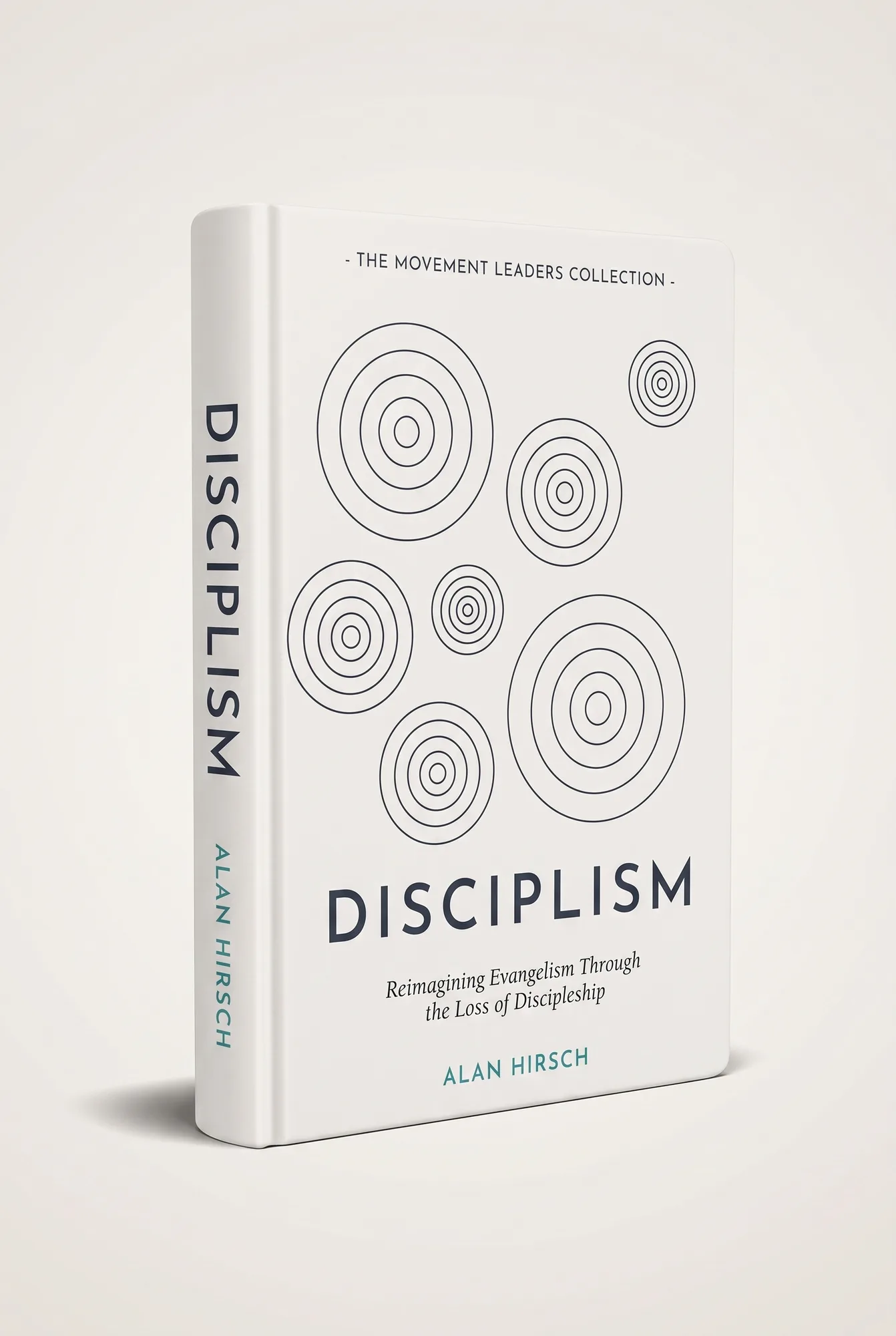
You get what you disciple for. If our discipleship does not produce self-replicating, missional apprentices of Jesus, then all our church growth is merely institutional shuffling.
In brief
Disciplism (2014) is a short manifesto written for the Exponential church-planting network. It argues that the church planting movement has a discipleship deficit because it treats evangelism and discipleship as separate departments. Its reframe is that evangelism is a dimension of discipleship from the very beginning: Jesus' call to follow was also a call to mission. Rooted in the Shema and obedience-based apprenticeship, it insists you get what you disciple for, and returns everything to Jesus himself.
On this page
The church in North America has a discipleship deficit, and no amount of church planting, polished branding, or evangelistic programming can compensate for it.
In 2014, I wrote Disciplism as a focused manifesto for the Exponential church planting network. For over a decade, the church-planting world had experienced remarkable growth. New networks were forming, conferences were swelling, and thousands of young planters were deploying into cities across the continent. Yet underneath the enthusiasm, a sobering reality was becoming apparent: we were planting churches faster than we were making disciples. We had divorced evangelism from discipleship, and as a result, we were reproducing the same consumerist, attractional patterns that had stalled the previous generation.
Disciplism was written to call the church back to its primary task: the lifelong, reproducible apprenticeship to Jesus that serves as the irreplaceable engine of every authentic movement.1
§ 1
Why This Book Exists
The modern church has largely treated evangelism and discipleship as two separate departments. Evangelism is seen as the initial transaction—getting someone over the line to pray a prayer, make a decision, or cross from darkness to light. Discipleship is then treated as the optional follow-up curriculum for those who want to go deeper.
This bifurcation has proved catastrophic. It produces "converts" who have affirmed a theological formula but have never counted the cost of following Jesus. When these converts populate our churches, they inevitably domesticate the community. They demand pastoral care, comfortable programming, and professional services, while remaining largely insulated from the missionary calling of God.
In The Forgotten Ways, I identified Disciple Making as Element 2 of mDNA, warning that if a community fails at this point, it is unlikely to succeed at any of the other five elements. In Untamed, Debra and I explored the deep personal formation required to recover an untamed discipleship. But by 2014, the church-planting movement urgently needed a concise, uncompromising manifesto that tackled the systemic failure at the heart of our methodologies.
Disciplism exists to declare that discipleship is the beginning, the middle, and the end of the Jesus movement.2
§ 2
The Central Reframe: Evangelism as a Dimension of Discipleship
The core reframe of Disciplism is that evangelism is not a separate precursor to discipleship: evangelism is a dimension of discipleship from the very beginning.
When Jesus invited the fishermen by the Sea of Galilee, he did not say, "Make a decision about my divinity, and then six months from now we will begin your discipleship class." He said, "Follow me, and I will make you fishers of men" (Matthew 4:19). The call to follow was simultaneously the call to mission. From day one, the disciples were apprenticed in the presence of Jesus—watching him heal, listening to him preach, learning his rhythms, and participating in his work.
Disciplism reframes the entire sequence:
- Pre-Conversion Discipleship: Helping seekers apprentice themselves to the ways of Jesus before they fully comprehend the theological doctrine.
- Obedience-Based Discipleship: Shifting the metric of maturity from what someone knows (cognitive accumulation) to what someone obeys (embodied practice).
- The Shema as Organizing Center: Rooting discipleship in the Shema (Deuteronomy 6:4–9), where the cosmic lordship of Jesus commands our total allegiance—heart, soul, mind, and strength.3
When discipleship is holistic and reproductive, evangelism happens naturally as a byproduct of transformed lives inhabiting the world.
§ 3
What the Book Actually Does
Disciplism is a concise, hard-hitting manifesto organized across six focused chapters.
Chapter 1
pp. 2–8
The End Game?
Opens with a diagnostic confrontation: What is the church actually trying to produce? If the goal of our ecclesial systems is producing attendees, consumers, or religious spectators, our current designs are succeeding brilliantly. If our goal is producing Christlike agents of the kingdom who reproduce their faith in others, our systems are failing. The chapter challenges leaders to define their end game before launching another program.4
Chapters 2–3
pp. 9–18
A Church Equal to the Task & Hear O Israel
Chapter 2, "A Church Equal to the Task," examines the scale of the cultural challenge facing the Western church, arguing that only a radical return to movemental discipleship can withstand secular pressure. Chapter 3, "Hear O Israel," grounds the entire argument in the Shema. Discipleship is learning to live under the exclusive lordship of the One God revealed in Jesus Christ, resisting the competing idolatries of consumerism, nationalism, and self-actualization.5
Chapters 4–5
pp. 19–28
Go Make Consumers & Reimagining Evangelism
Chapter 4, "Go Make Consumers of All the Nations?," exposes the tragedy of seeker-sensitive consumerism, demonstrating how tailoring church to consumer preferences creates disciples who consume church rather than embody Christ. Chapter 5, "Reimagining Evangelism," works out the practical shift from event-based extraction to relational, apprenticeship-led evangelism.6
Chapter 6
pp. 29–33
It's All About Jesus. No, Really, It Is.
Concludes the manifesto with an urgent Christological plea. Discipleship is not allegiance to a system, a church tradition, or a set of moral rules; it is radical, personal devotion to the living Person of Jesus Christ. If Jesus is not genuinely Lord of our imagination, our structures, and our daily schedules, discipleship is merely religious moralism.7
§ 4
Where This Book Sits in the Larger Body of Work
Disciplism belongs to the focused companion genre within this body of work, standing alongside The Forgotten Ways Handbook (2009) and Fast Forward to Mission (2011).
It serves as the strategic, movement-oriented update to Untamed (2010). Where Untamed worked as an expansive, 300-page exploration of the untamed God, self, culture, and mission, Disciplism is an urgent 40-page tract aimed squarely at church planters and denominational leaders.
The book directly reinforces Element 2 of mDNA: Disciple Making from The Forgotten Ways (2006). It also establishes the individual formational foundation for the systemic, fivefold organizational architecture that would arrive three years later in 5Q (2017).
§ 5
Who Needs to Read This
- The church planterwho has measured success by opening Sunday attendance and is realizing that a crowd does not equal a disciple-making community.
- The discipleship pastor or directorfrustrated by passive classroom Bible studies that fail to produce missionary Christians.
- The denominational leaderassessing why millions of dollars invested in church planting networks have produced so little net conversion growth.
- The practitionerseeking a sharp, readable manifesto to align their leadership team around the priority of reproduction.
§ 6
Where to Go Next
For readers seeking the full-length theological and personal exploration of lived apprenticeship, Untamed (2010, with Debra Hirsch) provides the foundational treatise.
For those wanting to see how multiplying disciples assemble into organic, viral networks, The Forgotten Ways (2006) charts the full sixfold architecture of Apostolic Genius.
Notes
7 notes
- The context and genesis of the Exponential manifesto: Disciplism, ch. 1, pp. 2–8. ↩
- The discipleship deficit in contemporary church planting: Disciplism, ch. 1–2, pp. 2–13. ↩
- The Shema of Deuteronomy 6 and Christological discipleship: Disciplism, ch. 3, pp. 14–18. ↩
- Diagnosing the true end game of church systems: Disciplism, ch. 1, pp. 2–8. ↩
- Resisting secular consumer idolatry through the Shema: Disciplism, ch. 3, pp. 14–18. ↩
- Critiquing consumer-driven church growth models: Disciplism, ch. 4–5, pp. 19–28. ↩
- Christological centrality in authentic discipleship: Disciplism, ch. 6, pp. 29–33. ↩
Works cited
Built from the notes · details from the books record
Hirsch, Alan. Disciplism: Reimagining Evangelism Through the Lens of Discipleship. Exponential / 100 Movements, 2014.
this book · cited 7× · notes 1, 2, 3, 4, 5, 6, 7
Sources drawn from
Disciplism (all chapters: "The End Game?," "A Church Equal to the Task," "Hear O Israel," "Go Make Consumers of All the Nations?," "Reimagining Evangelism," "It's All About Jesus. No, Really, It Is."); The Forgotten Ways (Disciple Making); Untamed (Going Out, Going Deep); ReJesus (The Shema Schema).
How these ideas evolved
Each concept in this book, and every book it runs through.
- Disciple Making
Develops here
- Jesus Is Lord
Develops here
- Missional-Incarnational Impulse
Develops here
Related works
- 02 · 2006The Forgotten WaysShares: Jesus Is Lord, Disciple Making, Missional-Incarnational Impulse

- 05 · 2010UntamedShares: Disciple Making, Jesus Is Lord, Missional-Incarnational Impulse

- 10 · 2012The Permanent RevolutionShares: Jesus Is Lord

- 03 · 2009The Forgotten Ways HandbookShares: Jesus Is Lord, Disciple Making, Missional-Incarnational Impulse